Does Emsculpt Work? What the Studies Measured
From the practice of
Brian V. Heil, MD, FACS, board certified plastic surgeon
Published November 26, 2026 · Updated
The studies say it changes the treated area. In a sham-controlled trial of Emsculpt NEO, ultrasound showed abdominal fat 28.3 percent thinner and the abdominal muscle 24.2 percent thicker at 3 months. The limits are real: the studies are small, nearly all are by authors who advise the manufacturer, and an independent review calls the evidence for efficacy tenuous.
How is Emsculpt supposed to work?
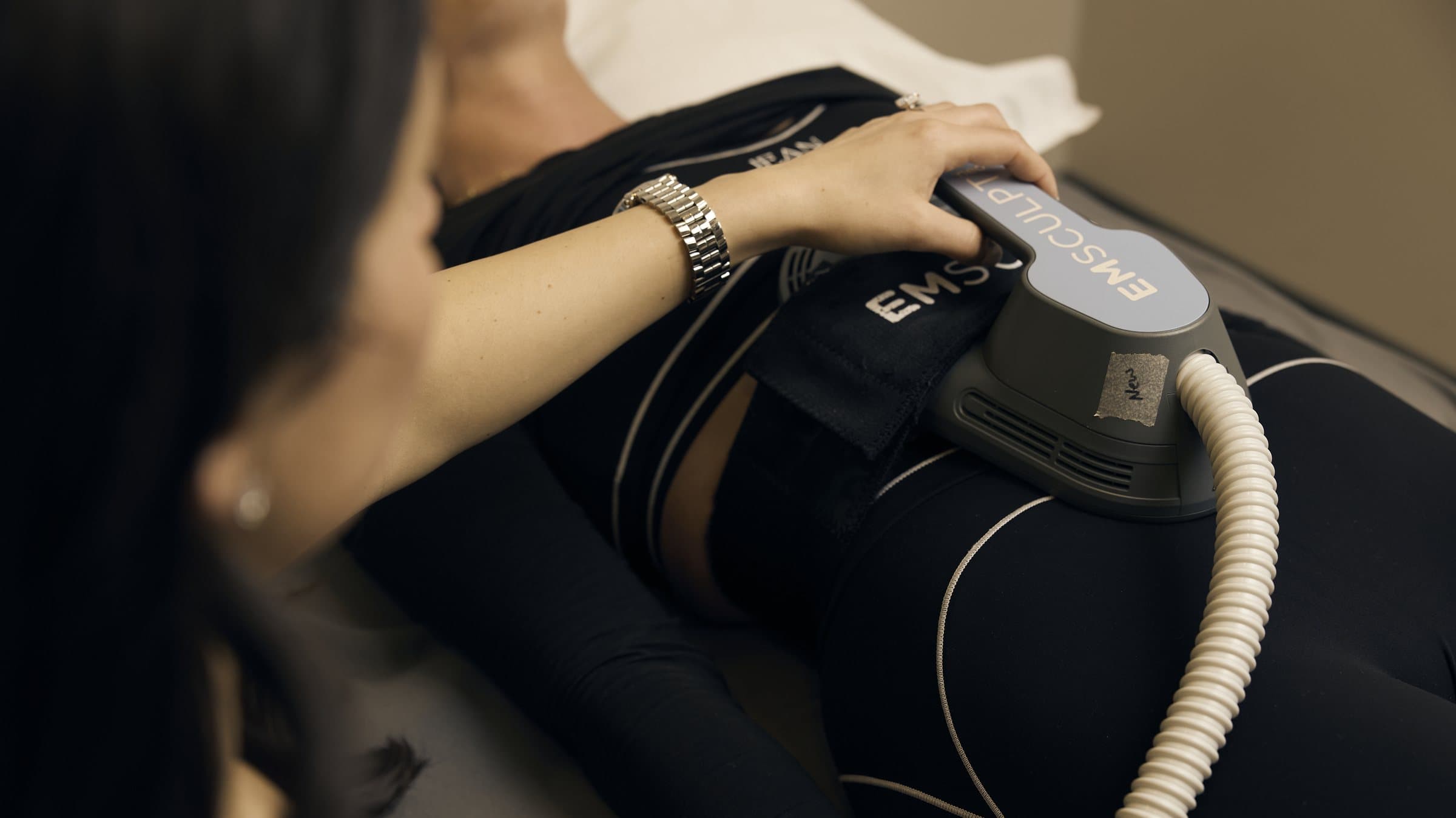
Emsculpt uses high-intensity focused electromagnetic (HIFEM) pulses. The FDA explains that pulsed magnetic fields work by triggering a small electric current in the muscles, and the pulse rate produces supramaximal muscle contractions which are not achievable voluntarily. Emsculpt NEO adds radiofrequency, which is used to increase the temperature of adipose tissue, damaging fat cells with heat in the same session.
The devices are FDA cleared through 510(k), not approved, and the clearances name BTL model numbers rather than brands. The BTL 799-2 was cleared in 2018 for improving abdominal tone and strengthening the abdominal muscles, and for toning the buttocks and thighs; a 2019 clearance added the calves and arms. The BTL-899, which combines bipolar radiofrequency with electromagnetic stimulation, was cleared in 2019 for non-invasive lipolysis (breakdown of fat) of the abdomen and reduction in abdominal circumference.
What did the studies actually measure?
| Study | Device | Area | People | How measured | Reported change | Follow-up | Funding and ties |
|---|---|---|---|---|---|---|---|
| Jacob and Paskova, 2018, J Cosmet Dermatol | HIFEM | Abdomen | 22 (19 completed) | Tape measure and photographs | Waist 4.37 cm smaller | 3 months | Author is a BTL medical advisor |
| Kinney and Lozanova, 2019, Lasers Surg Med | HIFEM | Abdomen | 22 | MRI | Fat 18.6% thinner, muscle 15.4% thicker, muscle separation 10.4% smaller | 2 months | First author is a BTL medical advisor |
| Kinney and Kent, 2020, Aesthet Surg J | HIFEM | Abdomen | 21 | MRI or CT | Fat 14.63% thinner | About 1 year (mean 332.6 days) | First author is a BTL medical advisor |
| Jacob, Kent and Ibrahim, 2021, Dermatol Surg | HIFEM with radiofrequency | Abdomen | 41 | MRI | Fat 30.8% thinner, muscle 26.1% thicker, waist 5.87 cm smaller at 3 months | 6 months | None reported; first author advises BTL in other studies |
| Samuels, Katz and Weiss, 2022, Plast Reconstr Surg | HIFEM with radiofrequency, against sham | Abdomen | 48 treated, 24 sham | Ultrasound | Fat 28.3% thinner, muscle 24.2% thicker at 3 months; no significant change with sham | 6 months | No funding received; all three authors are BTL medical advisors |
| Cohen and others, 2024, Aesthet Surg J | HIFEM with radiofrequency | Flanks | 73 enrolled, 61 analyzed | MRI | Fat 28.8% thinner, muscle 27.2% thicker | 3 months | Sponsored by BTL; authors are BTL investigators |
Imaging measures the layers themselves; a tape measure and photographs record only the outside. Converted out of percentages, the numbers are small: a 2024 systematic review pooled the abdominal studies at a mean reduction of 5.5 mm of fat, 2 mm of muscle gained and 3.0 mm less separation.
What does the evidence not show yet?
Independence, for a start. An independent systematic review of 14 studies found that 12 were authored by BTL medical editors or speakers, and that the two not funded by BTL found little or no treatment effect. The mean sample size was 26, only one study followed patients beyond 6 months, and the review found no controlled studies among those it included.
The combined device fares no better on that test. The same author’s 2025 review of HIFEM with radiofrequency found that all 7 studies were authored by BTL medical advisors and judged the measured changes likely within the margin of error. A separate 2024 review noted that two studies report marginal or no benefit. The sham-controlled trial in the table adds a comparison group, and its authors also advise the manufacturer.
Why do study results differ from one person to the next?
| Factor | What the studies report | Source |
|---|---|---|
| Starting body composition | With HIFEM alone, more significant improvements were seen in people at a normal BMI (18.5 to 24.9), and in leaner people the gain in muscle definition did most of the work. | Kinney 2019; Jacob and Paskova 2018 |
| HIFEM alone or with radiofrequency | The combined device’s authors report results exceeding those published for the separate treatments. That is a comparison across studies, not a head-to-head trial. | Samuels 2022 |
| Sex, age, skin type and BMI | In the sham-controlled trial of the combined device, outcomes were independent of skin type, sex, age and BMI. | Samuels 2022 |
| Treated area | Most of the studies in the table above treated the abdomen. The one flank study reported fat and muscle changes of a similar size. | Cohen 2024 |
What side effects have the studies reported?
Mild muscle soreness or fatigue the day after a treatment is the most often reported. In the clinical data behind the FDA clearance of the BTL-899, eleven of 42 subjects reported muscle soreness, one had mild redness, and no adverse events were recorded. In the sham-controlled trial, mild redness in several treated patients resolved within a few hours.
Less common: one person in the flank study developed a blister in the treatment area, and the FDA lists muscle soreness and cramps among the possible complications of muscle stimulation. The independent review judged the treatments safe, even where it doubted the effect. Who we treat, and who we do not, is set out on our Emsculpt NEO page.
What can you expect it to change, and what not?
We treat with Emsculpt NEO on the abdomen, upper arms, buttocks, thighs and calves. Emsculpt refines a body; it does not replace a lifestyle, and if fat alone is the concern, the consultation may point somewhere else, which is why we set out how Emsculpt NEO compares with CoolSculpting.
For sessions, timing and who is a candidate, see how a course of Emsculpt NEO runs here, and for the practice’s own patients, the Emsculpt NEO gallery. Individual results vary. Our introduction to Emsculpt NEO covers the device itself, and the rest of our body treatments are on their own page.
Frequently asked questions
Is Emsculpt the same as Emsculpt NEO?
No. A 2024 review describes Emsculpt as using high-intensity electromagnetic energy to build muscle, and Emsculpt NEO as combining that electromagnetic energy with radiofrequency, which heats the fat layer. The practice treats with Emsculpt NEO.
Is Emsculpt FDA approved?
It is FDA cleared, which is a different process from approval. The 510(k) clearances name BTL model numbers: the BTL 799-2 in 2018 for abdominal tone and for buttocks and thighs, with calves and arms added in 2019, and the BTL-899, which combines radiofrequency with electromagnetic stimulation, in 2019 for non-invasive lipolysis of the abdomen.
Does Emsculpt help with abdominal muscle separation after pregnancy?
The evidence is thin. A pilot study of 10 postpartum women measured by MRI reported a 22.7 percent (3.6 mm) reduction in abdominal separation at 3 months, and its author speaks for the manufacturer. An independent review found a mean decrease of 2.9 mm across studies that was not statistically significant.
Does Emsculpt help you lose weight?
No. The FDA says non-invasive body contouring will not result in weight loss and does not treat obesity. In one MRI study of the original device, the weight of the people treated did not change significantly, at an average of minus 0.5 lb.
More treatment questions are on the Acqua Blu blog.
Sources
- Kinney BM, Lozanova P. High intensity focused electromagnetic therapy evaluated by magnetic resonance imaging: Safety and efficacy study of a dual tissue effect based non-invasive abdominal body shaping. Lasers Surg Med. 2019;51(1):40-46. https://pubmed.ncbi.nlm.nih.gov/30302767/
- Jacob CI, Paskova K. Safety and efficacy of a novel high-intensity focused electromagnetic technology device for noninvasive abdominal body shaping. J Cosmet Dermatol. 2018;17(5):783-787. https://pubmed.ncbi.nlm.nih.gov/30225976/
- Kinney BM, Kent DE. MRI and CT Assessment of Abdominal Tissue Composition in Patients After High-Intensity Focused Electromagnetic Therapy Treatments: One-Year Follow-Up. Aesthet Surg J. 2020;40(12):NP686-NP693. https://pubmed.ncbi.nlm.nih.gov/32103232/
- Jacob C, Kent D, Ibrahim O. Efficacy and Safety of Simultaneous Application of HIFEM and Synchronized Radiofrequency for Abdominal Fat Reduction and Muscle Toning: A Multicenter Magnetic Resonance Imaging Evaluation Study. Dermatol Surg. 2021;47(7):969-973. https://pubmed.ncbi.nlm.nih.gov/34001694/
- Samuels JB, Katz B, Weiss RA. Radiofrequency Heating and High-Intensity Focused Electromagnetic Treatment Delivered Simultaneously: The First Sham-Controlled Randomized Trial. Plast Reconstr Surg. 2022;149(5):893e-900e. https://pmc.ncbi.nlm.nih.gov/articles/PMC9028295/
- Cohen J, Kilmer SL, DiBernardo B, et al. A Novel Approach to Shaping the Lateral Abdomen: Simultaneous Application of High-Intensity Focused Electromagnetic (HIFEM) Therapy and Synchronized Radiofrequency at the Flanks: A Multicenter MRI Study. Aesthet Surg J. 2024;44(8):850-858. https://pubmed.ncbi.nlm.nih.gov/38470830/
- Jacob CI, Rank B. Abdominal Remodeling in Postpartum Women by Using a High-intensity Focused Electromagnetic (HIFEM) Procedure: An Investigational Magnetic Resonance Imaging (MRI) Pilot Study. J Clin Aesthet Dermatol. 2020;13(4 Suppl):S16-S20. https://jcadonline.com/nppa-abdominal-remodeling-postpartum
- Swanson E. A Systematic Review of Electromagnetic Treatments for Body Contouring. Ann Plast Surg. 2023;90(2):180-188. https://pmc.ncbi.nlm.nih.gov/articles/PMC9869942/
- Swanson E. Body Contouring With Electromagnetic Treatment Plus Radiofrequency: A Review. Ann Plast Surg. 2025;94(2):250-256. https://pubmed.ncbi.nlm.nih.gov/39773625/
- Kohan J, Vyas K, Erotocritou M, Khajuria A, Tehrani K. High-Intensity Focused Electromagnetic (HIFEM) Energy With and Without Radiofrequency for Noninvasive Body Contouring: A Systematic Review. Aesthetic Plast Surg. 2024;48(6):1156-1165. https://pubmed.ncbi.nlm.nih.gov/37957393/
- US Food and Drug Administration. 510(k) K180813, BTL 799-2. 2018. https://www.accessdata.fda.gov/cdrh_docs/pdf18/K180813.pdf
- US Food and Drug Administration. 510(k) K190456, BTL 799-2L. 2019. https://www.accessdata.fda.gov/cdrh_docs/pdf19/K190456.pdf
- US Food and Drug Administration. 510(k) K192224, BTL-899. 2019. https://www.accessdata.fda.gov/cdrh_docs/pdf19/K192224.pdf
- US Food and Drug Administration. Non-Invasive Body Contouring Technologies. https://www.fda.gov/medical-devices/aesthetic-cosmetic-devices/non-invasive-body-contouring-technologies
- American Society of Plastic Surgeons. Get the facts on nonsurgical fat reduction: From CoolSculpting to Kybella. 2023. https://plasticsurgery.org/news/articles/get-the-facts-on-nonsurgical-fat-reduction-from-coolsculpting-to-kybella
Treatments at Acqua Blu Medical Spa in Upper St. Clair are provided under the direction of Brian V. Heil, MD, FACS, the practice’s founder and medical director. A consultation is the best way to find out what fits your skin and your goals.
This is general information, not medical advice. Candidacy and treatment parameters are determined by a licensed provider at a consultation.