
Laser Tattoo Removal in Pittsburgh
Roughly one in four people with a tattoo regrets it. Ink is hard to remove because it sits deep and its particles are large, and picosecond pulses are the current best answer to both problems.

Ready to start?
Book a consultWhy tattoos are hard to remove
Tattoo ink is injected into the dermis, a deep layer of skin, which means reaching it without damaging everything above it is the central difficulty. The particles are also large, and your immune system cannot clear them at that size, which is exactly why the tattoo has stayed put.
Colour matters too. Black and blue shades absorb laser energy readily and are the most straightforward to treat. Reds, yellows and greens are considerably harder, and older lasers often could not shift them at all.
PicoWay delivers energy in pulses measured in picoseconds, a trillionth of a second each. That speed breaks ink apart mechanically rather than by heating it, shattering particles small enough for your body to finally carry away.
Depth, ink colour, particle size and your own skin tone all change how a tattoo responds. Any honest estimate of how many sessions you need comes after someone has looked at yours.
Ink is placed in the dermis, well below the surface. Energy has to reach it without harming the layers above, which is what separates a good device from a crude one.
Blacks and blues absorb energy well and clear most predictably. Reds, yellows and greens are the stubborn end of the spectrum and typically need more sessions.
Ink particles are too large for the immune system to remove. The laser's job is to break them down into fragments small enough to be cleared naturally.
Your own skin pigment competes for the same energy, which affects what settings are safe. It is assessed before any treatment is scheduled.
Your body does the removing.The laser just breaks it up.
No laser lifts ink out of skin. It fragments the particles until they are small enough for your immune system to carry away, which happens gradually in the weeks between appointments. That is why sessions are spaced out, and why the tattoo keeps fading after you leave.
 Model
ModelYou are prepared for a course
Every tattoo takes multiple sessions spaced weeks apart. Anyone promising one-visit removal is not describing how this works.
You know your ink colours
Black and blue clear most readily. Reds, yellows and greens are harder and usually need more sessions, which is worth knowing before you start.
You want it gone, not covered
Removal and fading for a cover-up are different goals with different endpoints. Say which you want at the consultation.
You can protect the area
Treated skin needs sun protection between sessions, and the area should be kept out of the sun throughout the course.
Your skin has been assessed
Skin tone changes what settings are safe, since your own pigment competes for the same energy the ink absorbs.
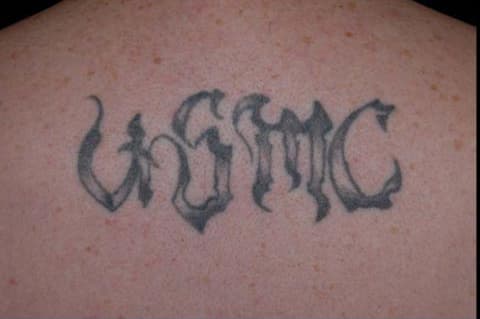
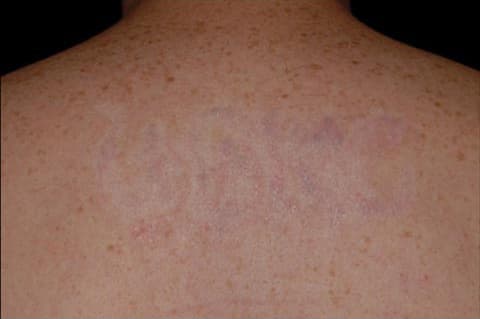
Nothing hereis an illustration.
Four cases from the practice's own records, spanning easy ink and hard. Drag the seam across each to see how completely the tattoo cleared, then browse the rest in the gallery.
View the full galleryPhotographs are of Acqua Blu patients, published by the practice. Individual results may vary.
Picoseconds are the entire trick.
Older tattoo lasers worked by heat: hold energy on the ink long enough and it breaks down, along with some of the skin holding it. Results were real, and so were the extra sessions and the scarring risk.
A picosecond pulse is a thousand times shorter. Ink shatters from the shockwave rather than cooking, the surrounding skin barely warms, and the fragments are small enough for your immune system to finally carry away.
That is the mechanism the video shows, and it is why the stubborn colours, the reds, yellows and greens that older machines could not shift, are on this page's menu at all.
Where it sitschanges how it goes.
Ink is ink, but circulation is not the same everywhere, and your immune system does the actual removing. Tattoos closer to the heart tend to clear faster than ones on the extremities.
Select any marker to see how location changes the course.
Four questions we are askedabout tattoo removal.
It depends on the ink colours, how deep and dense the tattoo is, whether it was professionally applied, and your own skin. A realistic number comes after someone has looked at it, not from a chart. Expect a course spaced weeks apart in every case.
Yes, though colour changes the difficulty. Blacks and blues respond most readily. Reds, yellows and greens are harder and typically need more sessions, which is one of the main reasons picosecond technology is an improvement on older lasers.
Most people compare it to the sensation of getting the tattoo, though each session is far shorter. Cooling is used throughout and we can discuss comfort options before starting.
Many tattoos clear entirely. Some leave faint shadowing, particularly with stubborn ink colours or very dense work. We will tell you honestly what we expect for yours rather than promise a blank slate.