Does Red Light Therapy Work for Hair Loss?
Medically reviewed by
Brian V. Heil, MD, FACS, board certified plastic surgeon
Published November 19, 2026 · Updated
Yes, modestly, for pattern hair loss. In four sham-controlled trials, a laser comb used three times a week added about 18 to 26 terminal hairs per cm² over 26 weeks, against about 2 to 9 with a sham device. It thickens follicles that are thinning, does not create them where the scalp is already bald, and takes months of regular use.
How does red light act on a hair follicle, and what have trials measured?
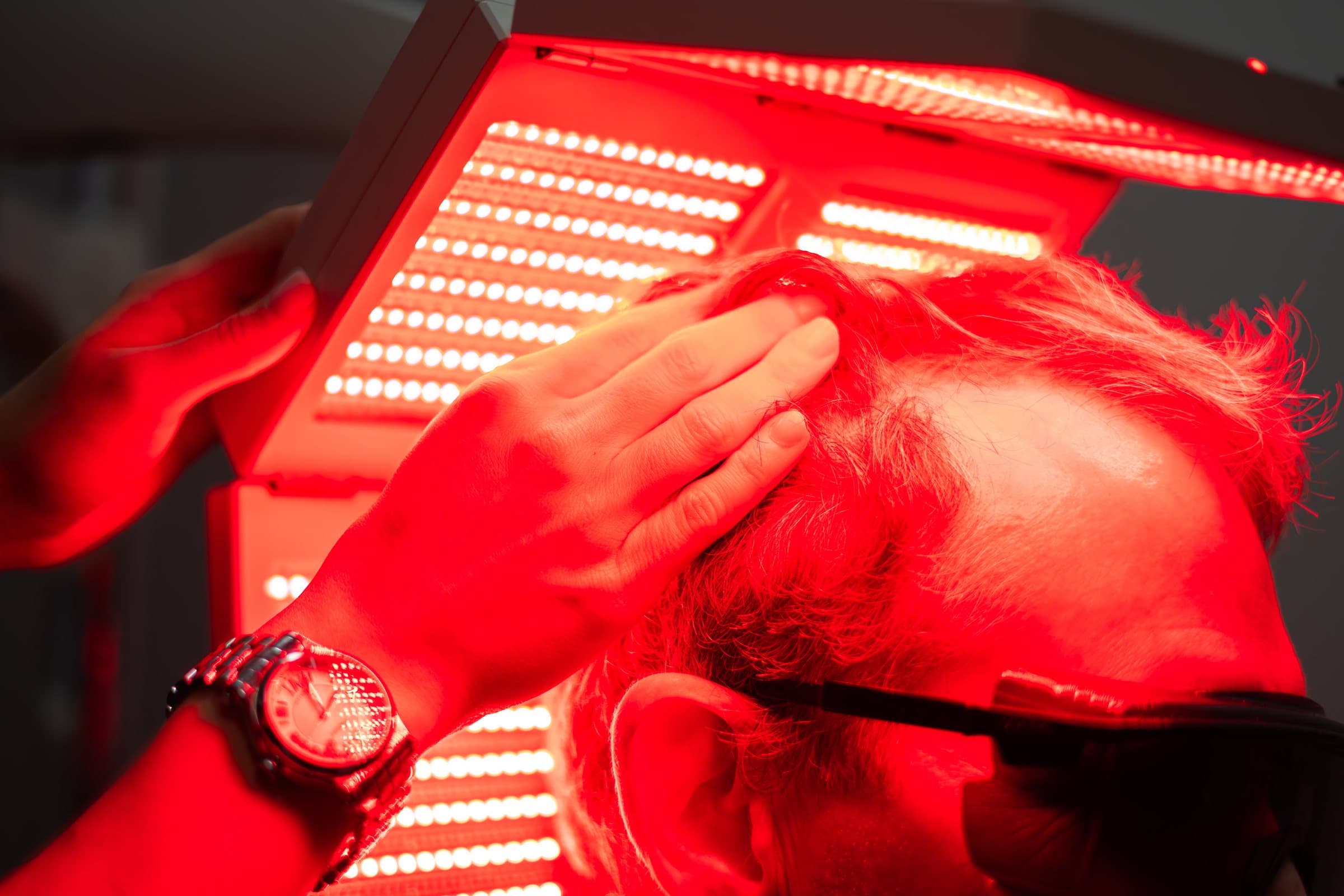
The working theory is photobiomodulation. One review says the evidence suggests the light acts on the mitochondria, at an enzyme called cytochrome c oxidase, raising the cell’s energy production. In the follicle it is assumed to bring resting hairs back into the growth phase, called anagen, and to keep them there longer.
The outcome trials count is hair density, and the pooled results favor the device. One meta-analysis of 11 double-blind randomized trials found a standardized effect of 1.32 over sham, and another, of 15 studies and 795 people, found 1.02. The caveats are real: the first was limited by how much its trials differed, a network meta-analysis rated the evidence for light against sham as very low in quality, and the trial behind the figures above was partly funded by the device’s maker.
On regulation, these devices are FDA cleared. The FDA lists them as Class II devices reviewed through 510(k), a submission that shows a device is substantially equivalent to one already legally marketed. Red light is one of several non-surgical options; another is PRP hair therapy.
What decides whether red light therapy works for you?
| Variable | What the research shows | Source |
|---|---|---|
| Type of hair loss | Studied for androgenetic (pattern) hair loss. For other types, the data were too few to pool. | A 2025 meta-analysis found insufficient data on other alopecia types. The AAD says the key to treatment is finding out what is causing the hair loss. |
| Stage of loss | Cleared for a range of patterns, not for every stage: men at Norwood-Hamilton IIa to V, women at Ludwig-Savin I-4, II-1, II-2 or frontal. | An FDA 510(k) clearance names those patterns, in Fitzpatrick skin types I to IV. |
| Time and consistency | Trials ran 16 to 26 weeks, with sessions from daily to three times a week, depending on the device. | Three times a week for 26 weeks; every other day for 16 weeks; 18 minutes daily for 24 weeks. A review notes no trial ran longer than 26 weeks. |
| Device type and dose | Unsettled. The best wavelength, dose and light source have not been established. | Most studies used wavelengths from 635 to 650 nm, and the review says the optimum remains to be determined. One meta-analysis found lasers more effective than laser and LED combined. |
| Combination with minoxidil | Mixed: some analyses find a gain, one does not. | A 2020 meta-analysis found a greater increase in hair count; a 2025 meta-analysis found no significant improvement. |
How are in-office red light sessions planned alongside other hair treatments?
We run the NeoGraft red light panel in our own treatment rooms. Sessions are timed at 15 to 30 minutes, seated under the panel, and you wear protective glasses for the duration. Your provider sets the schedule at the consultation and adjusts it as your scalp responds. Active scalp infection, some photosensitising medications and certain skin conditions are reviewed first and can rule the treatment out. See NeoGraft red light therapy sessions for how a visit runs.
We use it alongside PRP, medication or supplements for early thinning, or after a transplant. PRP in turn pairs with prescription medication, in-office red light therapy and supplements such as Nutrafol. Where thinning has become loss, the plan starts from our hair restoration and transplant options.
Is red light therapy safe, and when should hair loss be checked first?
The side effects reported in trials are mild. In the laser comb trials they were dry skin (5.1%), itching (2.5%), and scalp tenderness, irritation or a warm sensation (1.3% each), with no serious events. Another trial reported temporary hair shedding and scalp itching. The AAD says more studies are needed on whether these devices cause long-term side effects, and one review cautions against treating over abnormal or cancerous lesions on the scalp.
Some hair loss needs a diagnosis before any device. The AAD’s signs of sudden hair loss include a bald patch that appears within 1 or 2 days, clumps of hair coming out when you comb or brush, burning or stinging beforehand, intense itching or tenderness where the hair is lost, and scaly bald patches. Heavier shedding can also follow childbirth, illness, stress or a new medication. Diagnosis and candidacy are decided by a provider at a consultation.
Frequently asked questions
Is red light therapy FDA approved for hair loss?
No. These devices are FDA cleared, which is a different route. The FDA classifies laser hair growth devices as Class II and reviews them through 510(k), where a maker shows the device is substantially equivalent to one already legally marketed. The clearances cover androgenetic alopecia in named hair loss patterns and skin types.
Does red light therapy work for women’s hair loss?
The sham-controlled trials include women. In two 26-week trials of a laser comb, women gained about 20 terminal hairs per cm² against about 3 with a sham device, and a 16-week helmet trial reported a 37% greater increase in hair counts than sham. A 2026 review notes that randomized trials including women are still few.
Can red light therapy be used with minoxidil?
It has been studied that way, with mixed results. A trial in 45 women found the combination did better than either treatment alone, and a 2020 meta-analysis found light therapy with minoxidil increased hair count more than a single treatment. A 2025 meta-analysis of 4 trials found no significant gain over minoxidil alone.
Does red light therapy help alopecia areata?
The evidence is thin. A review describes one study of 15 patients in which hair regrew sooner in areas treated with an infrared light, and concludes that light only speeds regrowth in alopecia areata. A 2025 meta-analysis found too little data on other types of hair loss to pool, so the results for pattern hair loss do not carry over.
More on hair and skin is on the Acqua Blu blog.
Sources
- US Food and Drug Administration. Product Classification: laser, comb, hair (product code OAP, 21 CFR 890.5500). https://www.accessdata.fda.gov/scripts/cdrh/cfdocs/cfPCD/classification.cfm?id=OAP
- US Food and Drug Administration. 510(k) Premarket Notification K142573, indications for use. https://www.accessdata.fda.gov/cdrh_docs/pdf14/K142573.pdf
- US Food and Drug Administration. Premarket Notification 510(k). https://www.fda.gov/medical-devices/premarket-submissions-selecting-and-preparing-correct-submission/premarket-notification-510k
- Jimenez JJ, Wikramanayake TC, Bergfeld W, Hordinsky M, et al. Efficacy and safety of a low-level laser device in the treatment of male and female pattern hair loss: a multicenter, randomized, sham device-controlled, double-blind study. Am J Clin Dermatol. 2014;15(2):115-127. https://pmc.ncbi.nlm.nih.gov/articles/PMC3986893/
- Avci P, Gupta GK, Clark J, Wikonkal N, Hamblin MR. Low-level laser (light) therapy (LLLT) for treatment of hair loss. Lasers Surg Med. 2014;46(2):144-151. https://pmc.ncbi.nlm.nih.gov/articles/PMC3944668/
- Liu KH, Liu D, Chen YT, Chin SY. Comparative effectiveness of low-level laser therapy for adult androgenic alopecia: a system review and meta-analysis of randomized controlled trials. Lasers Med Sci. 2019;34(6):1063-1069. https://pubmed.ncbi.nlm.nih.gov/30706177/
- Gupta AK, Carviel JL. Meta-analysis of photobiomodulation for the treatment of androgenetic alopecia. J Dermatolog Treat. 2021;32(6):643-647. https://pubmed.ncbi.nlm.nih.gov/31746251/
- Gupta AK, Mays RR, Dotzert MS, Versteeg SG, et al. Efficacy of non-surgical treatments for androgenetic alopecia: a systematic review and network meta-analysis. J Eur Acad Dermatol Venereol. 2018;32(12):2112-2125. https://pubmed.ncbi.nlm.nih.gov/29797431/
- Lueangarun S, Visutjindaporn P, Parcharoen Y, Jamparuang P, et al. A Systematic Review and Meta-analysis of Randomized Controlled Trials of United States Food and Drug Administration-Approved, Home-use, Low-Level Light/Laser Therapy Devices for Pattern Hair Loss: Device Design and Technology. J Clin Aesthet Dermatol. 2021;14(11):E64-E75. https://pmc.ncbi.nlm.nih.gov/articles/PMC8675345/
- Perez SM, Vattigunta M, Kelly C, Eber A. Low-Level Laser and LED Therapy in Alopecia: A Systematic Review and Meta-Analysis. Dermatol Surg. 2025;51(2):179-183. https://pubmed.ncbi.nlm.nih.gov/39404126/
- Lanzafame RJ, Blanche RR, Bodian AB, Chiacchierini RP, et al. The growth of human scalp hair mediated by visible red light laser and LED sources in males. Lasers Surg Med. 2013;45(8):487-495. https://pubmed.ncbi.nlm.nih.gov/24078483/
- Lanzafame RJ, Blanche RR, Chiacchierini RP, Kazmirek ER, et al. The growth of human scalp hair in females using visible red light laser and LED sources. Lasers Surg Med. 2014;46(8):601-607. https://pubmed.ncbi.nlm.nih.gov/25124964/
- Kim H, Choi JW, Kim JY, Shin JW, et al. Low-level light therapy for androgenetic alopecia: a 24-week, randomized, double-blind, sham device-controlled multicenter trial. Dermatol Surg. 2013;39(8):1177-1183. https://pubmed.ncbi.nlm.nih.gov/23551662/
- Suchonwanit P, Chalermroj N, Khunkhet S. Low-level laser therapy for the treatment of androgenetic alopecia in Thai men and women: a 24-week, randomized, double-blind, sham device-controlled trial. Lasers Med Sci. 2019;34(6):1107-1114. https://pubmed.ncbi.nlm.nih.gov/30569416/
- Esmat SM, Hegazy RA, Gawdat HI, Abdel Hay RM, et al. Low level light-minoxidil 5% combination versus either therapeutic modality alone in management of female patterned hair loss: A randomized controlled study. Lasers Surg Med. 2017;49(9):835-843. https://pubmed.ncbi.nlm.nih.gov/28489273/
- Zhou Y, Chen C, Qu Q, Zhang C, et al. The effectiveness of combination therapies for androgenetic alopecia: A systematic review and meta-analysis. Dermatol Ther. 2020;33(4):e13741. https://pubmed.ncbi.nlm.nih.gov/32478968/
- Alosaimi A, Algarni A, Alharbi A, Alotaibi A, et al. Comparative efficacy of minoxidil alone versus minoxidil combined with low-level laser therapy in the treatment of androgenic alopecia: a systematic review and meta-analysis. J Dermatolog Treat. 2025;36(1):2447355. https://pubmed.ncbi.nlm.nih.gov/39828269/
- Kearney CA, Brinks AL, Lawrence CN, Maas DE, et al. Androgenetic Alopecia in Women: A Narrative Review of Pathophysiology, Clinical Evaluation, and Treatments. Am J Clin Dermatol. 2026;27(2):363-389. https://pubmed.ncbi.nlm.nih.gov/41714473/
- American Academy of Dermatology. Hair loss: Diagnosis and treatment. https://www.aad.org/public/diseases/hair-loss/treatment/diagnosis-treat
- American Academy of Dermatology. Hair loss: Signs and symptoms. https://www.aad.org/public/diseases/hair-loss/insider/begin
- American Academy of Dermatology. Hair loss: Who gets and causes. https://www.aad.org/public/diseases/hair-loss/causes/18-causes
Treatments at Acqua Blu Medical Spa in Upper St. Clair are provided under the direction of Brian V. Heil, MD, FACS, the practice’s founder and medical director. A consultation is the best way to find out what fits your skin and your goals.
This is general information, not medical advice. Candidacy and treatment parameters are determined by a licensed provider at a consultation.