One of the practice's most effective scar treatments, breaking up the tethering that holds an indentation down.
RejuvaPen microneedling
Scars are one of the most common complaints patients bring us, and most of them never need surgery. Here is how microneedling, lasers and peels give a scar a second chance to heal, and where surgical revision still fits.
The first step is knowing what kind of scar you have. Keloid scars come from overcompensation during healing: the body produces too much scar tissue and the scar protrudes outward. Hypertrophic scars are raised and red, also driven by excess collagen. Contracture scars follow burns, pulling the skin tight and sometimes hindering movement. And acne scars arrive after severe acne has cleared, leaving a dimpled or pitted look our practitioners treat every week.
Because each type heals differently, each one wants a slightly different treatment. Acqua Blu is a nonsurgical medical spa first, and in many cases the team finds nonsurgical solutions that let patients avoid surgery entirely. When a scar genuinely does require surgical revision, Dr. Brian Heil, the practice's board-certified plastic surgeon, offers reconstructive scar revision. A clinical diagnosis at the consultation decides which path yours is on.

Sound familiar?
Book a consult
For indented scars, the microneedling treatments work on what holds the scar down. RejuvaPen passes a cartridge of nine microneedles over the scar to break up the fibrous tethering that pins its indentation in place, so the body's own healing rebuilds a smoother surface without surgery or lasers. It works on acne scarring first and foremost, but also on scarring elsewhere on the body, including stretch marks. Fractional RF microneedling on the Fraxis Duo adds energy to the mechanism: superfine needles carry radiofrequency deep into the dermis while a fractional CO2 laser works the surface, and acne scarring can realistically expect around 50% improvement across a five-session plan.
The lasers remove damaged tissue instead. CO2 laser resurfacing vaporizes damaged skin in a pattern of microscopic columns that reach into the scar itself, leaving healthy tissue between them to speed healing: it is the strongest tool the practice has for the physical surface of skin, acne and surgical scarring included. HALO delivers an ablative and a non-ablative wavelength in the same pass, resurfacing the epidermis while rebuilding collagen in the dermis, which suits skin where acne scarring sits alongside uneven tone and texture.
Chemical peels round out the set for the shallowest damage. Controlled exfoliation lifts away the outermost layers where acne scarring and post-acne marks sit near the surface, pushing fresher skin forward over a series of treatments.
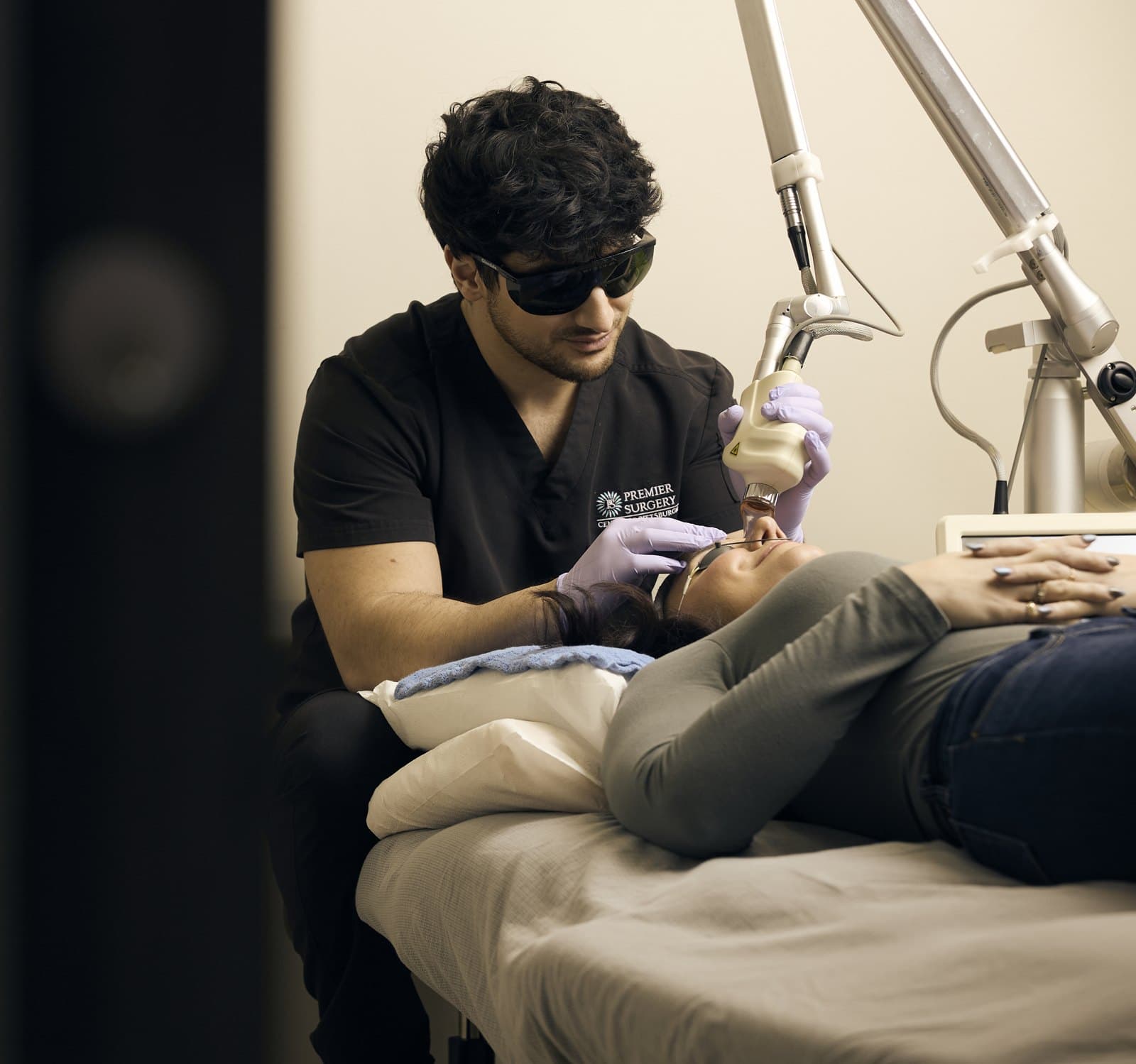
Depth is the honest organizing question. Discolored marks and shallow texture respond to peels; indented, tethered scars want microneedling; deep or widespread scarring points to RF microneedling, resurfacing or HALO, where a bigger result costs more recovery. CO2 resurfacing means about a week of redness, crusting and peeling, RejuvaPen about 48 hours of redness, and HALO a few days of sunburn-like redness followed by bronzing and fine shedding.
Expectations matter as much as technology. Scarring is permanent, and no treatment completely removes it: what these treatments do is break up or replace what makes a scar read as a scar, which very visibly improves it. Results also build rather than arrive; microneedling plans typically run three or more sessions, and collagen keeps remodeling for weeks after each one. For background on the acne-scar side specifically, see which solutions fit which types of acne scars and what microneedling can do.
The consultation is where the type of scar gets its clinical diagnosis and the plan gets its shape. Dr. Heil and his team of physician assistants determine the exact treatment necessary, including the rare case where surgical revision truly is the right answer.
Listed in the order we most often recommend them. Your consultation decides which actually fits your skin, goals, and downtime.
One of the practice's most effective scar treatments, breaking up the tethering that holds an indentation down.
RejuvaPen microneedling
Needles and radiofrequency reach the depth of the scar, with around 50% acne-scar improvement over five sessions.
RF microneedling
The strongest tool on the menu for the physical surface of skin, acne and surgical scarring included.
CO2 laser resurfacing
Surface renewal and deep collagen remodeling in one pass, for scarring that sits amid uneven tone and texture.
HALO
Controlled exfoliation for the shallowest scarring and post-acne marks, built up over a series.
Chemical peelsThis page is general information, not medical advice. Which treatment fits your skin and history is a clinical decision made at a consultation with our providers.