How to Stop Hair Loss: What Works for Each Cause
From the practice of
Brian V. Heil, MD, FACS, board certified plastic surgeon
Published November 28, 2026 · Updated
Whether you can stop hair loss depends on its cause. Pattern hair loss can often be slowed or held with FDA-approved treatment, and the earlier treatment starts, the better it works. Hair shed after illness, childbirth or stress usually regains its normal fullness within 6 to 9 months. Scarring loss needs a dermatologist early, because a destroyed follicle cannot regrow a hair.
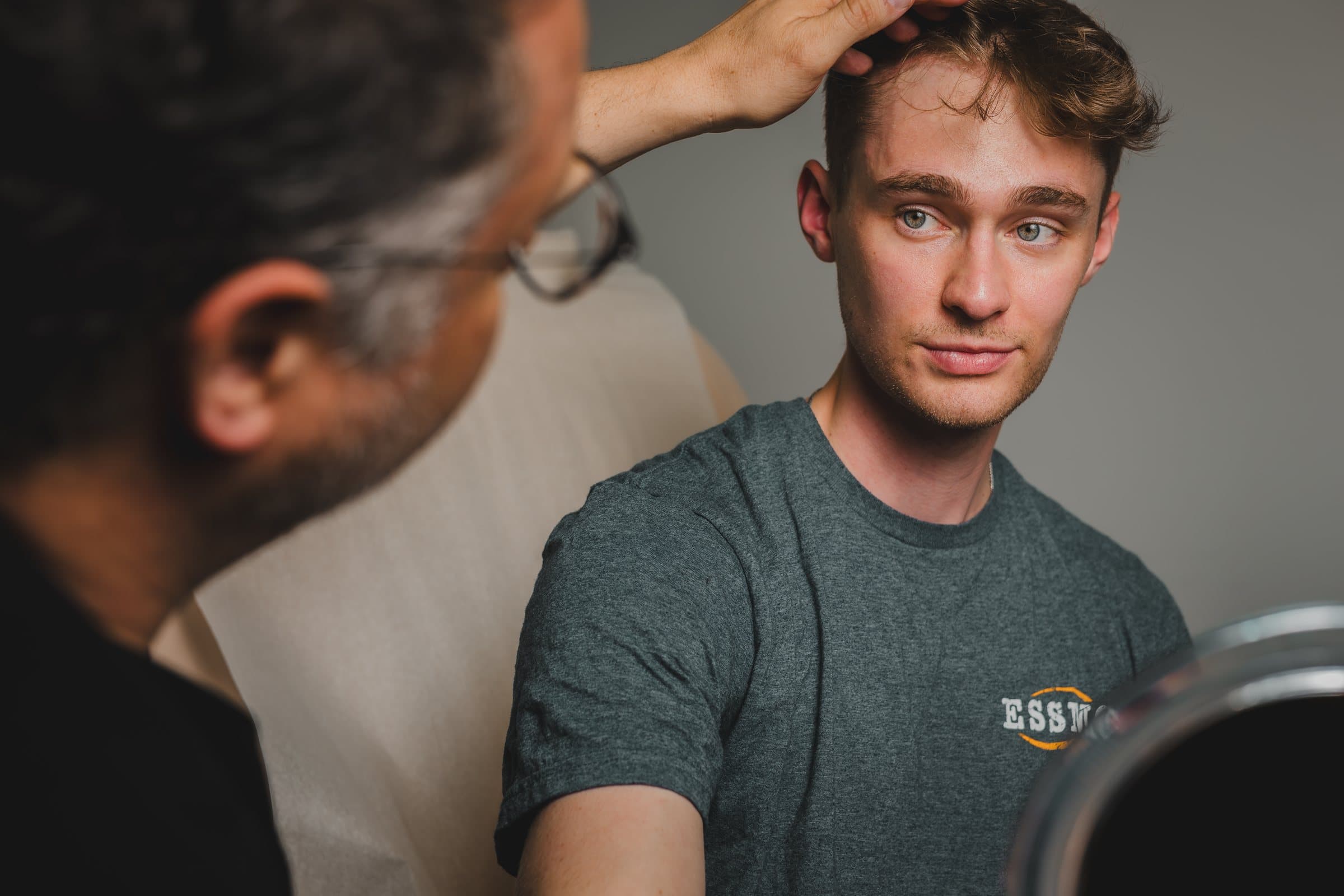
Why is your hair falling out?
Most hair loss comes down to the growth cycle. A scalp hair grows for years in its active phase, called anagen, then rests in telogen for 1 to 4 months before it falls, and up to 10% of a normal scalp is resting at any time. Shedding of 50 to 100 hairs a day is normal. The types below differ in which part of that cycle goes wrong, and whether the follicle survives it.
| Type | What it looks like | Usual trigger |
|---|---|---|
| Pattern hair loss (androgenetic alopecia) | Gradual thinning on top and a receding hairline; in women, more often a widening part. | Hereditary. The AAD calls it the most common cause of hair loss worldwide. |
| Excessive shedding (telogen effluvium) | Many more hairs in your brush or on your pillow, 2 to 4 months after the trigger. | Childbirth, high fever, an operation, illness, losing 20 pounds or more, heavy stress or stopping birth-control pills. |
| Alopecia areata | Sudden loss, often a round or oval, smooth bald patch. | The immune system attacks the hair follicles. |
| Traction alopecia | Broken hairs around the forehead, a receding hairline, or patches where hair is pulled tight. | Tight hairstyles worn often. It can become permanent the longer it goes untreated. |
| Scarring alopecia | Bald patches with no visible follicles; some forms burn, sting or itch. | Inflammation destroys the hair follicles. |
Which treatments slow pattern hair loss?
Topical minoxidil is the over-the-counter option, with separate men’s and women’s labels. The men’s label is for regrowth on the top of the scalp and is not intended for a receding hairline. Both say not to use it if your loss is sudden or patchy, if there is no family history of hair loss, if you do not know the reason for it, or if you are under 18. The AAD says it can help early hair loss but cannot regrow an entire head of hair.
Its labels list the reasons to stop and ask a doctor: chest pain, a rapid heartbeat, faintness or dizziness, sudden weight gain, swollen hands or feet, and unwanted facial hair. They also say it may be harmful if used when pregnant or breastfeeding.
Finasteride is a prescription drug indicated for male pattern hair loss in men only. Its label says it is not indicated for women, is contraindicated in women who are or may become pregnant, and that such women should not handle crushed or broken tablets. Side effects in its trials included decreased libido, erectile dysfunction and ejaculation disorder, and reports after approval include depression, suicidal thoughts and sexual problems that continued after stopping.
| Option | FDA status | What the evidence shows |
|---|---|---|
| Topical minoxidil | FDA-approved, non-prescription, for men and women | Some regrowth for many people, usually after about 6 to 12 months; works better alongside another treatment. |
| Finasteride | FDA-approved prescription, men only | Benefit after three months or more of use; stopping reverses the effect within 12 months. |
| Oral minoxidil | Off-label: its tablets are approved only for high blood pressure | Small studies suggest it may be safe and effective; larger trials and standard guidelines are lacking. |
| Spironolactone | Off-label, for female pattern hair loss | The AAD says studies show it effective in about 40% of women with this loss. It can cause birth defects. |
| PRP (platelet-rich plasma) | In-office procedure using your own plasma | Early findings show promise, per the AAD. One review found no statistical difference between PRP alone and topical minoxidil alone. |
| Low-level light | FDA-cleared devices | Few studies, with promising results, and not everyone sees regrowth. |
| Hair transplant | Surgical procedure | Moves your own follicles, but hair loss and thinning can continue after a transplant. |
For light therapy, the trials and their limits are in does red light therapy work for hair loss. Off-label use is a decision for your provider, made against your own history.
How long before you know a treatment is working?
Months, because new hair has to come through a full growth cycle before you can see it. The men’s minoxidil label says results may occur at 2 months, though some men need at least 4; the women’s label says 3 months, and at least 6 for some. The AAD’s figure is longer, about 6 to 12 months. If you see no regrowth by 4 months (men) or 6 months (women), the labels say to stop and ask a doctor.
Finasteride’s label says three months or more of use is usually needed before benefit shows; the AAD puts noticeable improvement at about 4 months. For alopecia areata treated with steroid injections, the AAD says regrowth, when it comes, usually shows within 3 months of the first injection.
Shedding after a trigger runs on its own clock. It starts 2 to 4 months after the event and tapers back to normal over 6 to 9 months in most cases. The trigger sets the timing: after childbirth, the AAD says shedding usually peaks about four months after giving birth.
What can we do about each kind of loss?
Your consultation with Dr. Heil (Brian V. Heil, MD, FACS) decides the plan. Diffuse thinning, some medical causes of loss and very early recession often want medication or PRP first. Where a transplant is not the right first step, we offer PRP hair therapy, NeoGraft red light therapy and medical management of hair loss, alone or alongside a transplant plan.
PRP pairs with prescription medication, in-office red light therapy and supplements such as Nutrafol, a physician-formulated hair growth supplement that we carry for home use.
When is hair loss a reason to see a doctor?
Some signs point to a cause that needs diagnosing first. The AAD lists a bald patch or strip that appears within 1 or 2 days, clumps of hair coming out, burning or stinging beforehand, intense itching or tenderness, and scaly bald patches with sores. Cleveland Clinic adds sudden loss of large amounts of hair and excessive daily shedding. Scarring types need speed: for frontal fibrosing alopecia, the AAD says caught early, medical treatment can stop further hair loss, and the same holds for central centrifugal cicatricial alopecia.
The tests are usually simple. Cleveland Clinic says a provider may order blood tests to measure thyroid function and iron levels, and the AAD notes some people need a blood test or a scalp biopsy. If you think a medicine is behind it, the AAD says not to stop taking it before talking with your doctor. Diagnosis and any medication are decided by a provider at a consultation.
To see the transplant and non-surgical routes side by side, start with our hair restoration options. More on hair and skin is on the Acqua Blu blog.
Sources
- American Academy of Dermatology. Hair loss: Who gets and causes (18 causes of hair loss). https://www.aad.org/public/diseases/hair-loss/causes/18-causes
- American Academy of Dermatology. Do you have hair loss or hair shedding? https://www.aad.org/public/diseases/hair-loss/insider/shedding
- American Academy of Dermatology. Hair loss: Signs and symptoms (how to tell if hair loss is beginning). https://www.aad.org/public/diseases/hair-loss/insider/begin
- American Academy of Dermatology. Female pattern hair loss. https://www.aad.org/public/diseases/hair-loss/types/female-pattern
- American Academy of Dermatology. Alopecia areata: Symptoms. https://www.aad.org/public/diseases/hair-loss/types/alopecia/symptoms
- American Academy of Dermatology. Alopecia areata: Diagnosis and treatment. https://www.aad.org/public/diseases/hair-loss/types/alopecia/treatment
- American Academy of Dermatology. Hairstyles that can lead to hair loss. https://www.aad.org/public/diseases/hair-loss/causes/hairstyles
- American Academy of Dermatology. Hair loss: Diagnosis and treatment. https://www.aad.org/public/diseases/hair-loss/treatment/diagnosis-treat
- American Academy of Dermatology. Hair loss: Hair transplant. https://www.aad.org/public/diseases/hair-loss/treatment/transplant
- American Academy of Dermatology. Central centrifugal cicatricial alopecia (CCCA). https://www.aad.org/public/diseases/hair-loss/types/ccca
- American Academy of Dermatology. Frontal fibrosing alopecia. https://www.aad.org/public/diseases/hair-loss/types/frontal-fibrosing-alopecia
- DermNet. Hair loss. https://dermnetnz.org/topics/hair-loss
- DermNet. Telogen effluvium. https://dermnetnz.org/topics/telogen-effluvium
- Cleveland Clinic. Hair Loss. https://my.clevelandclinic.org/health/diseases/21753-hair-loss
- Cleveland Clinic. Telogen Effluvium. https://my.clevelandclinic.org/health/diseases/24486-telogen-effluvium
- NHS. Hair loss. https://www.nhs.uk/conditions/hair-loss/
- DailyMed (US National Library of Medicine). Men's minoxidil topical foam, Drug Facts label. https://dailymed.nlm.nih.gov/dailymed/drugInfo.cfm?setid=1b5e2860-6855-4a65-8bbc-e064172a1adf
- DailyMed (US National Library of Medicine). Women's minoxidil topical foam, Drug Facts label. https://dailymed.nlm.nih.gov/dailymed/drugInfo.cfm?setid=4d328537-b7f5-43cc-9837-c5a0c6c390f8
- DailyMed (US National Library of Medicine). PROPECIA (finasteride) prescribing information. https://dailymed.nlm.nih.gov/dailymed/drugInfo.cfm?setid=6f904709-65aa-44ce-b144-b4c8a0416e36
- DailyMed (US National Library of Medicine). Minoxidil tablets prescribing information. https://dailymed.nlm.nih.gov/dailymed/drugInfo.cfm?setid=8f3800f0-b6da-4dfe-8c32-39bb5eb0262a
- Akiska YM et al. Low-dose oral minoxidil initiation for patients with hair loss: an international modified Delphi consensus statement. JAMA Dermatol. 2025;161(1):87-95. https://jamanetwork.com/journals/jamadermatology/article-abstract/2826573
- Fabbrocini G et al. Female pattern hair loss: A clinical, pathophysiologic, and therapeutic review. Int J Womens Dermatol. 2018;4(4):203-211. https://pmc.ncbi.nlm.nih.gov/articles/PMC6322157/
- Gupta AK et al. Platelet-rich plasma as a treatment for androgenetic alopecia. Skin Appendage Disord. 2023;9(6):397-406. https://pmc.ncbi.nlm.nih.gov/articles/PMC10697753/
- Patel DP, Swink SM, Castelo-Soccio L. A Review of the Use of Biotin for Hair Loss. Skin Appendage Disord. 2017;3(3):166-169. https://pmc.ncbi.nlm.nih.gov/articles/PMC5582478/
- US Food and Drug Administration. Product Classification: laser, comb, hair (product code OAP). https://www.accessdata.fda.gov/scripts/cdrh/cfdocs/cfPCD/classification.cfm?id=OAP
- US Food and Drug Administration. Biotin Interference with Troponin Lab Tests: Assays Subject to Biotin Interference. https://www.fda.gov/medical-devices/in-vitro-diagnostics/biotin-interference-troponin-lab-tests-assays-subject-biotin-interference
FAQ
Does stress cause hair loss, and does the hair grow back?
It can. The American Academy of Dermatology lists a stressful event, such as a divorce or losing a job, among the triggers of excessive shedding, which most people notice a few months later. Cleveland Clinic says the hair grows back, and the AAD says it tends to regain its normal fullness within 6 to 9 months, though DermNet notes recovery is incomplete in some cases.
Do biotin supplements stop hair loss?
There is no good evidence they do in healthy people. A 2017 review found biotin has no proven efficacy for hair growth in healthy individuals. The FDA warns that biotin in supplements can significantly interfere with certain lab tests, including falsely low troponin results, so tell your doctor if you take it.
What happens if you stop using minoxidil?
The hair it was holding is lost again. The over-the-counter labels say continued use is necessary to increase and keep regrowth, or hair loss will begin again, and the AAD says that if you stop applying minoxidil, you lose its benefits.
Is hair loss in women treated the same way as in men?
Not entirely. Topical minoxidil has over-the-counter labels for women and for men, but finasteride is labelled for men only and must not be used by women who are or may become pregnant. Spironolactone is used off-label for female pattern hair loss and can cause birth defects, and the AAD says women who are or may become pregnant should not take prescription hair loss medicines.
Can hair loss from a medical condition be reversed?
Often, if the follicles are intact. The NHS says hair loss caused by a medical condition usually stops or grows back once you have recovered, and the AAD says treating thyroid disease can reverse the hair loss it causes. Scarring hair loss is the exception: once a follicle is destroyed, it cannot regrow a hair.
Treatments at Acqua Blu Medical Spa in Upper St. Clair are provided under the direction of Brian V. Heil, MD, FACS, the practice’s founder and medical director. A consultation is the best way to find out what fits your skin and your goals.
This is general information, not medical advice. Candidacy and treatment parameters are determined by a licensed provider at a consultation.